Section 60 expenses under the new reasonable and necessary test
Published by Darran Russell
What insurers need to know from 1 October 2026
From 1 October 2026, the test for new treatment and service claims under section 60 of the Workers Compensation Act 1987 changed from “reasonably necessary” to “reasonable and necessary”. Insurers should update treatment decisions, medical instructions and approval processes to address the new wording and the prescribed rules. The date of the treatment claim matters: some earlier claims remain subject to the former test. [1]
Our view is that the practical change will be in the quality and focus of the evidence. A recommendation should explain why the particular treatment is needed, why it is clinically justified and why its cost represents value for money. A conclusion that treatment may help, without that explanation, is more vulnerable to challenge.
Which claims are affected
The change covers medical or related treatment, hospital treatment, ambulance services and workplace rehabilitation services. SIRA confirms that new treatment or service claims made on or after 1 October 2026 attract the new test. Under Schedule 6, Part 19R, clause 21, the former law continues for earlier treatment claims that were not finally determined before commencement, or were approved but the treatment had not been provided or completed.[1]
An old injury date does not, by itself, preserve the former test for every future treatment request. Equally, an invoice or treatment date after 1 October does not, by itself, establish that the new test applies. Identify the request and what it covered. For example, distinguish completion of an approved course from a request for an additional course. Resolve uncertainty about the scope of an existing approval before changing the test applied to it. The relevant date is generally when the claim for the particular treatment was made—not when the worker was injured, treated or invoiced.
The section 60 change also applies to exempt workers, coal miners and volunteers, although the application of associated amendments differs for coal miners and volunteers. Dust disease claims fall outside these changes.[2]
What the new rules require
Clause 8P of the Workers Compensation Regulation 2016 requires the primary purpose of the treatment or service to be treating the injury that is the subject of the claim. It must also be clinically justified, cost-effective and represent value for money. Value for money involves comparing cost with the benefits achieved and the cost of alternative treatments or services. These are prescribed requirements, rather than simply a list of useful considerations.[3]
We recommend addressing each requirement expressly. Clinical justification should explain the diagnosis, the treatment target and the expected benefit for the worker. A value-for-money assessment should compare realistic options over a relevant period. A higher upfront cost may be justified if it produces a material benefit or avoids prolonged ineffective care. A cheaper option should not be preferred merely because it is cheaper.
Clause 8Q separately excludes specified treatment and service costs. The exclusions include alternative health care, life and wellness coaching, and energy and healing practices. Massage and general health, fitness, social or recreational activities have prescription qualifications. Prescription does not automatically establish entitlement: the applicable treatment test must still be met. Companion animal costs have separate commencement and saving provisions.[3]
Why the wording matters
In Clampett v WorkCover Authority of NSW [2003] NSWCA 52 at [22]–[24], the Court of Appeal explained that “reasonably” moderates the absolute quality otherwise conveyed by “necessary”. The case concerned home modifications, so its particular statutory context matters. Its explanation of the composite expression informed later section 60 decisions. [6]
In Diab v NRMA Ltd [2014] NSWWCCPD 72 at [86]–[90], Roche DP explained that the former test did not require absolute necessity or proof that the treatment was reasonable and necessary. Several treatments could qualify. Relevant considerations included suitability, alternatives and their effectiveness, cost, actual or potential benefit, and medical support. These considerations assisted the assessment; they did not replace the statutory question. A poor outcome did not necessarily mean treatment had been unjustified. [7]
CTP decisions distinguish the two expressions and treat “reasonable and necessary” as being more demanding. That supports an expectation of closer scrutiny under the amended section 60. However, it does not establish that treatment must be life-saving, guarantee recovery or be the only conceivable option. The amended workers compensation legislation and regulations remain the starting point; the CTP examples below are guidance, not decisions interpreting the new section 60.[8], [9], [10]
How CTP decisions explain the stricter test
The CTP authorities help explain why adding “and” is substantive. Under section 3.24(2) of the Motor Accident Injuries Act 2017, treatment must be reasonable and necessary in the worker’s circumstances and must relate to the accident injury. Those are distinct questions. AAI Limited t/as GIO v Barnes [2025] NSWPICMP 273 expressly approaches the assessment by considering causation first, then whether the surgery was reasonable and whether it was necessary. A link to the accident does not, on its own, answer the treatment question. [13]
In practical terms, we recommend asking whether the proposal is a sensible clinical response, and then why the worker needs that response. The answers may rely on overlapping evidence but should explain more than the possibility of some benefit. The following decisions show how clinical findings, treatment history and current medical advice inform that assessment.
Hines shows how an aggravation can make surgery necessary
In Insurance Australia Limited t/as NRMA Insurance v Hines [2024] NSWPICMP 494, the Panel confirmed that a left knee replacement was reasonable and necessary. The worker had longstanding osteoarthritis, previously managed conservatively. Following the accident, symptoms became persistent and debilitating and conservative management was no longer appropriate. The Panel considered that the accident-related aggravation necessitated replacement surgery, which would improve recovery and usual activities. [14]
For insurers, pre-existing disease and the possibility of eventual surgery should prompt investigation of why surgery is needed now. They do not automatically answer the claim. The useful comparison is the worker’s function and treatment needs before and after the compensable aggravation.
Barnes confirms that the assessment is specific to the worker.
In AAI Limited t/as GIO v Barnes [2025] NSWPICMP 273, the Panel described the CTP requirement as stricter than the former workers compensation test because “reasonably” no longer moderated necessity. It confirmed that the relevant circumstances were those of the individual worker. Cervical decompression surgery was found reasonable and necessary after considering the history, accident-related symptoms, medical findings and improvement following surgery. [13]
Actual improvement can therefore support the assessment of treatment already undertaken. Our recommendation is still to examine the full clinical justification: a favourable result should not be treated as automatically resolving causation, necessity or every other entitlement requirement.
Farr shows why a conditional proposal requires further evidence
In Farr v Insurance Australia Limited t/as NRMA Insurance [2024] NSWPICMP 768, decided under the Motor Accidents Compensation Act 1999, the Panel accepted an accident-related cervical condition but rejected a proposed fusion. The surgical opinion was three years old and contemplated surgery after conservative options were exhausted. Current clinical support was insufficient. The Panel also said that failure of all conservative options would not automatically justify fusion.[15]
The Panel criticised the failure to facilitate conservative care and further specialist advice. For insurers, the lesson is to establish whether surgery is actually recommended now, obtain current reasons and consider the suitable alternative care. Declining a particular operation does not establish that no treatment is payable.
What these decisions mean for the amended section 60
Together with Sarwary, El-Kazzi and Mataraci (discussed below), these decisions support a fact-specific assessment. They show a stricter test being applied to approve some requests and reject others, rather than a blanket rule against surgery, symptom management or treatment of an aggravated condition. [6], [7], [8], [13], [14], [15]
These are Medical Review Panel decisions, not appellate Court rulings which bind the workers compensation jurisdiction. Hines and Barnes concern the 2017 CTP Act; Farr concerns the earlier 1999 Act. Their reasoning is useful by analogy, but the amended section 60 and clause 8P must govern the insurer’s decision. In particular, observations about CTP guidelines cannot displace the express clinical justification and value-for-money rules now prescribed for workers compensation. We recommend using the cases to frame medical questions and explain decisions, rather than importing every CTP rule into section 60.
The expected differences in practice
The following comparison separates the established former approach from our expectations for the amended test. It should be read with the transitional provisions and the prescribed rules.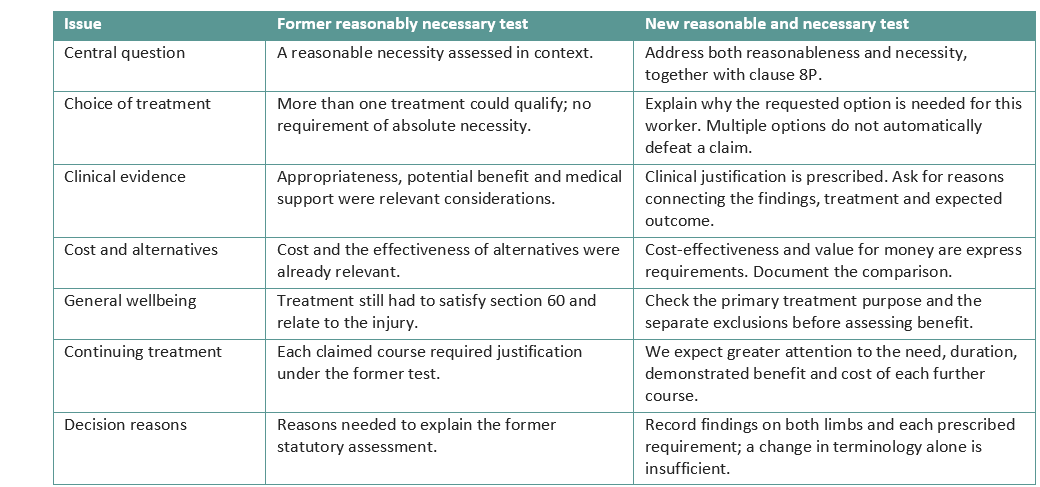 Sources for the legal comparison: [2], [3], [4], [5], [6], [7], [8]. Predictions about claims handling are our recommendations, rather than settled outcomes under the amended section 60.
What CTP decisions can teach insurers
Sarwary shows why individual circumstances matter
In Sarwary v Allianz Australia Insurance Limited [2023] NSWPICMP 125, the Panel approved a TENS machine. It distinguished the stricter CTP test from the former workers compensation test, while using the Diab considerations as guidance. The machine was inexpensive, suitable for the worker’s circumstances and had potential to reduce pain and reliance on medication, without adverse effects. The Panel rejected treating a single research-evidence criterion as determinative of the whole statutory question.[8]
For insurers, the lesson is to evaluate the particular request and worker. General research remains relevant, but the decision should explain how that research applies to the proposed treatment. Sarwary does not permit an insurer to disregard the mandatory requirements now prescribed by the workers compensation regulations.
El Kazzi separates causation from treatment justification
In El-Kazzi v Insurance Australia Limited t/as NRMA Insurance [2024] NSWPICMP 591, the Panel accepted that the accident aggravated a degenerative cervical condition. It nevertheless rejected proposed cervical surgery and nerve blocks. The current findings did not support those interventions, the treatment aims were unclear, risks and benefits were insufficiently explained, and modified conservative treatment remained an option. The Panel described reasonableness and necessity as separate matters to consider. [9]
The practical lesson is that accepting an injury does not require approval of every proposed treatment. Instructions to medical experts should ask separately about the injury’s contribution to the need for treatment and the justification for the particular intervention. A refusal should address the proposal, rather than merely repeat that degeneration exists.
Mataraci shows how surgery can satisfy the stricter test
In Allianz Australia Insurance Limited v Mataraci [2025] NSWPICMP 536, the Panel confirmed approval of L5/S1 decompression and fusion. It found an accident-related aggravation with radiculopathy, supported by clinical and imaging evidence. Extensive conservative treatment had failed. The anticipated benefit, specialist opinions and cost comparison supported surgery. The Panel considered the likely cost against the continuing cost of conservative care. [10]
The lesson is to compare the actual options. Failed conservative care can strengthen the justification for surgery. It should not become a reason to require repetition of the same unsuccessful treatment. Conversely, these facts do not establish a rule that radiculopathy is essential for every surgical approval.
A recommended process for treatment decisions
We recommend the following process for new requests subject to the amended test. The sequence is a practical decision framework; it does not add eligibility requirements to the legislation.
Step 1: Identify the treatment claim and applicable test
Record when the request was made, the treatment sought, its scope and any earlier approval. Check whether the transitional saving applies. Record the basis for selecting the former or amended test. Escalate unclear requests rather than assume that the injury date or invoice date answers the question.
Step 2: Check the separate entitlement requirements
Identify the compensable injury, the expense category, any applicable section 59A treatment period, approval requirements, fee limits and provider requirements. Check the current Guidelines and clause 8Q exclusions. Meeting the treatment test does not resolve these separate questions.[1], [2], [3], [4], [5], [11]
Step 3: Establish the treatment purpose and injury connection
Ask which condition the proposed service will treat and why it is needed because of the work injury. Where other conditions contribute, obtain an explanation of their role. Document whether treating the claimed injury is the primary purpose. General wellbeing or incidental benefit should not stand in for that assessment.
Step 4: Obtain a clear clinical justification
Request the diagnosis, relevant examination and investigation findings, treatment goals, proposed frequency and duration, expected benefit and material risks. Ask why the treatment is needed now and what is likely to happen without it. The clinician should explain the reasoning, rather than simply adopt the statutory words.
Step 5: Examine realistic alternatives
Identify what has been tried, for how long and with what result. Ask whether a different treatment, revised program or self-management approach is clinically suitable and practically available. If the treating recommendation and insurer’s opinion differ, compare their reasons and factual assumptions. Do not resolve the disagreement by counting reports.
Step 6: Assess cost effectiveness and value for money
Obtain a sufficiently detailed quote and compare the likely benefits and costs of realistic alternatives. Include the relevant course of treatment, associated rehabilitation and likely continuing care. Explain why a less expensive option would or would not provide comparable benefit. Keep the assessment proportionate to the expense and complexity.
Step 7: Determine and explain the decision
Record separate conclusions on whether the treatment is reasonable and whether it is necessary. Then explain how the evidence satisfies, or fails to satisfy, each clause 8P requirement. If information is missing, identify the precise gap and seek targeted clarification. An information request should not be treated as automatically extending a statutory decision deadline.
For an approval, specify the authorised treatment and its scope. For a dispute, identify the relevant legal ground, evidence and reasons, and comply with the applicable notice and review requirements. Check the section 279 decision timeframe and any shorter Guidelines requirements.[12]
Step 8: Review further requests against their own evidence
For continuing care, agree practical review measures such as pain control, function, medication use or capacity for daily activities. Assess further requests using updated evidence. Avoid automatic renewal, but also avoid assuming that maintenance or symptom relief has no clinical value merely because the worker has not recovered fully.
What insurers should change now
Update templates and medical instructions so that they prompt reasons addressing the amended requirements. Train claims teams to identify saved treatment claims, separate causation from treatment justification and make meaningful cost comparisons. Review complex or high-cost disputes early, especially where the expert evidence uses the former expression without addressing the current rules.
Rankin Ellison Lawyers can assist insurers with treatment disputes, medical instructions and the application of the transitional provisions. A clear decision supported by the right evidence is more useful than a checklist completed with unexplained conclusions.
This article provides general information about NSW workers compensation law as at 1 October 2026. Individual claims require consideration of their facts and the applicable legislative provisions.
Sources and further reading
1 Workers Compensation Act 1987 section 60 and Schedule 6 Part 19R clause 21
2 SIRA commencement and transitional guidance for insurers
3 Workers Compensation Regulation 2016 Part 4A including clause 8P
4 SIRA guidance on the prescribed rules
5 SIRA guidance on excluded treatment and service costs
6 Clampett v WorkCover Authority of NSW [2003] NSWCA 52 at [22] to [24]
7 Diab v NRMA Ltd [2014] NSWWCCPD 72 at [86] to [90]
8 Sarwary v Allianz Australia Insurance Limited [2023] NSWPICMP 125
9 El-Kazzi v Insurance Australia Limited t/as NRMA Insurance [2024] NSWPICMP 591
10 Allianz Australia Insurance Limited v Mataraci [2025] NSWPICMP 536
11 Workers Compensation Guidelines from 1 October 2026 Part 4
12 Workplace Injury Management and Workers Compensation Act 1998 section 279
13 AAI Limited t/as GIO v Barnes [2025] NSWPICMP 273
14 Insurance Australia Limited t/as NRMA Insurance v Hines [2024] NSWPICMP 494
15 Farr v Insurance Australia Limited t/as NRMA Insurance [2024] NSWPICMP 768
Contributors
Darran Russell Partner
Mary-Jean Lewis Special Counsel